

 24 Hour Emergency Aid
1. Introduction: Why Does My Left Chest Hurt?
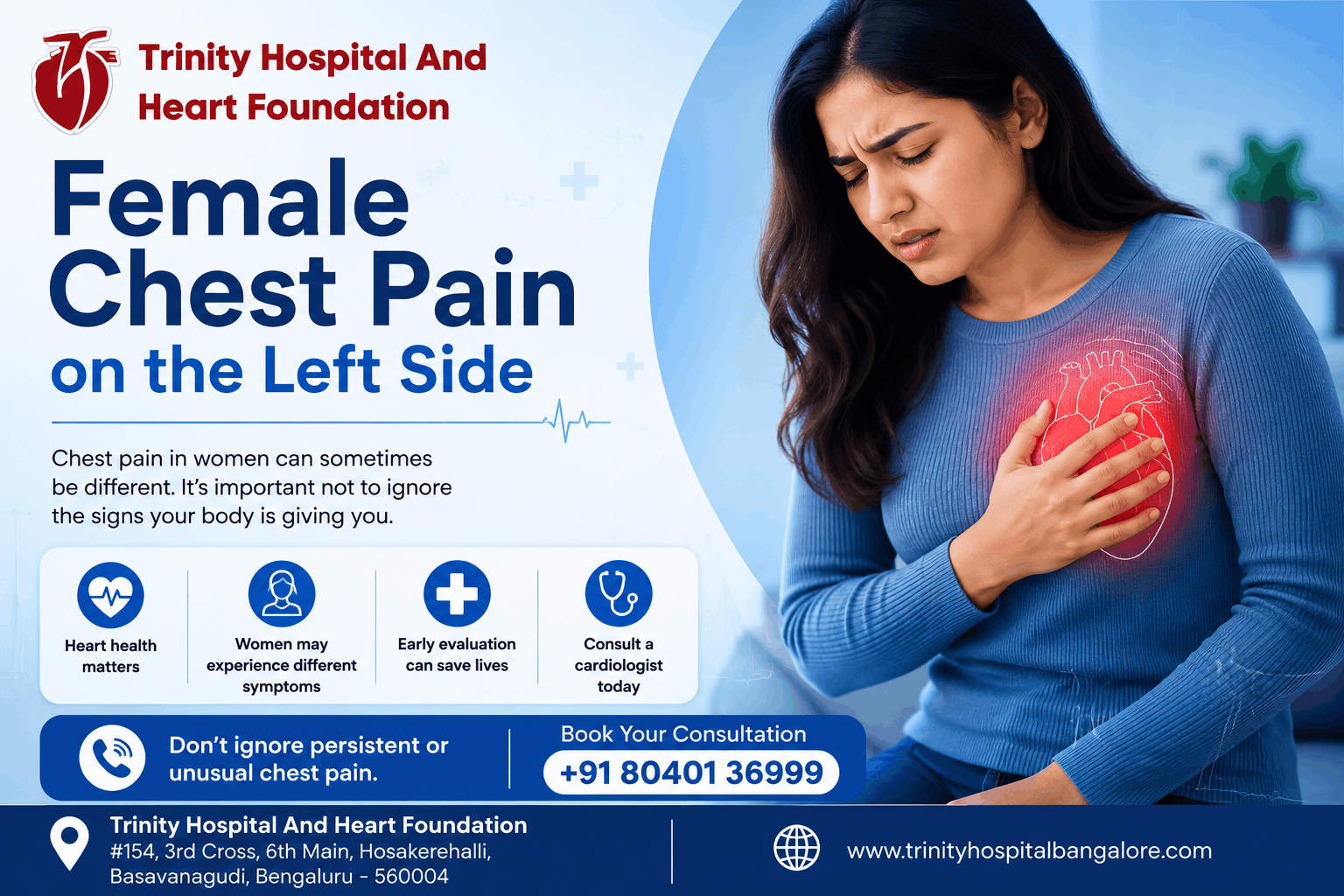
Why does my left chest hurt? It is a common question, particularly when the discomfort is felt on the left side and there is concern that it may be related to the heart. For women, understanding female chest pain left side symptoms is especially important because heart-related problems can sometimes occur with chest discomfort alongside symptoms such as breathlessness, nausea, unusual tiredness, or discomfort in the back, jaw, shoulder, or arm.
Book Appointment
At the same time, not every pain in left side of chest is caused by a heart condition. Chest discomfort can also arise from the muscles and chest wall, digestive system, lungs, or other causes. For example, muscle pain in left side chest, reflux, or anxiety may produce symptoms that feel similar to cardiac discomfort. Because these causes can overlap, symptoms alone should not be used to determine the cause.
For women living in or around Basavanagudi, Bangalore, persistent or unexplained chest discomfort can be assessed through a structured cardiac evaluation. Trinity Hospital and Heart Foundation provides cardiology services including evaluation of chest pain, breathlessness and cardiac risk factors, along with diagnostic and interventional cardiac care.
The important distinction is not simply whether pain occurs on the left or right side. Doctors consider the character, duration, triggers, associated symptoms, medical history and cardiovascular risk factors before deciding whether further testing is necessary.
If chest discomfort is new, severe, persistent, or accompanied by symptoms such as significant breathlessness, sweating, nausea, faintness, or pain spreading to the arm, back, neck or jaw, prompt medical assessment is appropriate.
2. Understanding Left-Side Chest Pain in Women
What Can Cause Left-Side Chest Pain in Females?
Left side chest pain in females can have several possible causes. Some are related to the heart, while others involve muscles, the digestive system, lungs, or nerves.
Common possibilities include:
Heart-related causes
Heart-related chest discomfort can occur with conditions such as:
- Coronary artery disease
- Angina
- Heart attack
- Inflammation around the heart
- Other cardiovascular conditions
Heart-related discomfort does not always present as dramatic or severe pain. Women may experience chest pressure or discomfort together with shortness of breath, nausea, unusual fatigue, sweating, dizziness, or discomfort involving the back, shoulder, arm, neck or jaw.
Muscle and chest-wall causes
A left chest muscle pain sensation may occur following physical activity, repetitive movement, coughing, lifting, or an injury.
Possible causes include:
- Chest muscle strain
- Chest-wall inflammation
- Rib or soft-tissue injury
- Musculoskeletal tension
Pain that changes noticeably with certain movements or when the chest wall is pressed may have a musculoskeletal component, although this does not by itself rule out other causes.
Digestive causes
Acid reflux and other digestive problems can sometimes cause burning or discomfort in the chest. Heartburn can feel similar to cardiac chest discomfort, which is why unexplained chest pain should not automatically be assumed to be acidity.
Lung-related causes
Certain lung conditions can also cause chest pain, particularly pain associated with breathing, coughing, or breathlessness. These conditions require medical assessment when symptoms are significant or unexplained.
What Are the Chest Pain Women Symptoms to Watch For?
The phrase chest pain women symptoms covers a broad range of experiences. Possible symptoms include:
- Chest pressure, tightness or discomfort
- Burning or aching sensation
- Shortness of breath
- Unusual tiredness or weakness
- Nausea or vomiting
- Cold sweating
- Dizziness or lightheadedness
- Discomfort in the arm or shoulder
- Back, neck or jaw discomfort
- Symptoms that appear during physical activity or emotional stress
Women can experience many of the same heart attack symptoms as men, but accompanying symptoms may differ and can sometimes be overlooked.
What Causes Chest Pain on the Left Side in Women?
When asking what causes chest pain on the left side in women, it is useful to consider both cardiac and non-cardiac possibilities.
Doctors may consider:
- Heart and coronary artery conditions
- Muscle or chest-wall problems
- Acid reflux and digestive conditions
- Lung-related conditions
- Anxiety or panic symptoms
- Previous injury
- Other medical conditions
A person’s age, family history, blood pressure, diabetes, cholesterol, smoking status and previous heart problems may also influence the evaluation.
The presence of a particular symptom does not confirm a specific diagnosis. A healthcare professional may need to examine the patient and decide whether tests are appropriate.
Practical Things to Keep in Mind
If you experience recurrent chest discomfort, note useful information such as:
- When the discomfort began
- How long it lasts
- Whether it occurs during activity or at rest
- Whether it comes and goes
- Whether breathing or movement affects it
- Whether there is breathlessness
- Whether discomfort spreads to another area
- Any associated nausea, sweating or dizziness
- Any known cardiovascular risk factors
This information can help a doctor understand the pattern of symptoms.
Avoid assuming that recurring chest pain is simply gas, anxiety, or muscle pain without appropriate evaluation, particularly when symptoms are new or changing.
3. Types of Treatment for Female Chest Pain
There is no single treatment for chest pain because treatment depends on its underlying cause.
Non-Surgical or Conservative Approaches
When chest pain is not caused by a condition requiring an intervention, management may focus on the underlying problem.
Depending on the diagnosis, this may involve:
- Lifestyle modifications
- Appropriate medicines
- Physical rehabilitation for selected musculoskeletal conditions
- Management of blood pressure, diabetes or cholesterol
- Treatment for acid reflux or other digestive conditions
- Follow-up monitoring
Patients should use medicines only as directed by their healthcare professional.
If chest discomfort is suspected to be cardiac, evaluation may include an ECG, blood tests, echocardiography, cardiac imaging or other investigations depending on the clinical situation. The American Heart Association notes that evaluation of suspected heart attack can include ECG, blood tests and imaging such as echocardiography or coronary angiography.
Interventional or Surgical Treatment
If evaluation identifies significant coronary artery disease, treatment may include medication, coronary angioplasty with stenting, or coronary artery bypass grafting (CABG), depending on the coronary anatomy and individual clinical circumstances.
Trinity Hospital provides:
- Coronary angiography and stenting (PCI) for selected coronary artery blockages.
- Angioplasty as a minimally invasive treatment for appropriate coronary artery disease.
- CABG for selected patients with severe or complex coronary disease when surgery is appropriate.
- Complex angioplasty approaches for selected challenging coronary lesions.
The choice between medical treatment, angioplasty and surgery should be made after appropriate cardiac assessment rather than based on symptoms alone.
4. Cost and Other Considerations
The cost of evaluating or treating chest pain can vary substantially because chest pain is a symptom rather than a single disease.
Factors that may influence overall cost include:
- Consultation requirements
- Number and type of diagnostic tests
- ECG or echocardiography
- Blood investigations
- Advanced cardiac imaging
- Coronary angiography, when indicated
- Whether angioplasty or surgery is required
- Type and number of stents or grafts, where applicable
- Hospitalisation and monitoring
- Medicines and follow-up
- Management of other medical conditions
A person with musculoskeletal chest pain may require a very different evaluation from someone with suspected coronary artery disease.
Treatment costs vary according to the patient’s condition, investigations required, treatment selected, hospital stay and other individual factors. A consultation is necessary to determine what evaluation or treatment is appropriate.
5. Why Choose Trinity Hospital and Heart Foundation for Cardiac Evaluation?
Trinity Hospital and Heart Foundation is a multispecialty hospital in Basavanagudi, Bangalore, with a focus on cardiac care. Its cardiology services include evaluation of chest pain and breathlessness, angiography, angioplasty and structured follow-up. (trinityhospitalbangalore.com)
The hospital’s approach includes:
- Cardiology assessment for chest pain and cardiac risk factors
- Diagnostic services including ECG and echocardiography
- Coronary angiography when clinically indicated
- Interventional cardiology services
- Cardiac surgery for selected patients
- Coordinated care between cardiology and cardiac surgery
- Post-treatment monitoring and follow-up
The hospital’s cardiology and cardiac surgery departments provide complementary services, including angiography, angioplasty, CABG, valve surgery and minimally invasive cardiac surgery.
Book Appointment
Dr. B. G. Muralidhara
Dr. B. G. Muralidhara, listed by Trinity Hospital as a Senior Interventional Cardiologist/Chief Cardiologist, is associated with the hospital’s cardiology services and cardiac evaluation. The hospital’s published information describes his clinical work in diagnostic angiography and the evaluation of coronary artery disease.
The objective of consultation is not to assume that chest pain is cardiac, but to understand the symptoms and determine whether further cardiac evaluation is appropriate.
6. CTA: When Should You Get Chest Pain Evaluated?
If you are experiencing recurrent or unexplained female chest pain left side, it is reasonable to discuss the symptoms with a healthcare professional rather than trying to determine the cause yourself.
A cardiology evaluation may be particularly appropriate when chest discomfort:
- Repeatedly occurs during physical activity
- Is becoming more frequent or intense
- Is associated with breathlessness
- Occurs with dizziness or unusual fatigue
- Is accompanied by palpitations
- Occurs in someone with known cardiovascular risk factors
- Is new or unexplained
If chest pain is severe or accompanied by significant breathlessness, sweating, faintness, nausea, or discomfort spreading to the arm, back, neck or jaw, seek emergency medical care rather than waiting for a routine appointment. Heart attack symptoms can sometimes begin gradually or come and go.
Trinity Hospital and Heart Foundation provides cardiac evaluation in Basavanagudi, Bangalore.
Phone: +91 80401 36999
Address: Teachers College Circle, near Rashtriya Vidyalaya Road, Basavanagudi, Bengaluru, Karnataka 560004.
