

 24 Hour Emergency Aid
1. Introduction / Overview
Understanding the ICU vs CCU difference can be difficult when a family member is admitted to a hospital. Terms such as ICU, CCU, ICCU and cardiac ICU are often used during stressful situations, and families may wonder whether one unit is more serious than another or why a patient has been moved to a particular area.
An ICU, or Intensive Care Unit, is designed to provide close monitoring and advanced support for patients with serious or potentially life-threatening medical conditions. A cardiac care unit or coronary care unit, commonly called a CCU, is generally focused on patients who require intensive monitoring or treatment because of serious heart-related conditions.
However, terminology can differ between hospitals. Some hospitals use CCU to mean Cardiac Care Unit or Coronary Care Unit, while others may use terms such as ICCU or CICU for specialised cardiac intensive care. Therefore, the exact meaning should always be confirmed with the treating hospital.
The difference between ICU and CCU in hospital is primarily related to the patient population and clinical focus. ICU care can involve several organ systems, whereas a cardiac-focused CCU concentrates particularly on cardiovascular conditions.
For families in Basavanagudi, Bangalore, understanding these terms can make conversations with the healthcare team easier. Trinity Hospital and Heart Foundation provides cardiology and cardiac-care services, including evaluation and treatment for a range of cardiovascular conditions.
The purpose of this article is to explain ICU vs CCU, what these units do, who may need them, and what families can generally expect—without attempting to determine which unit an individual patient requires.
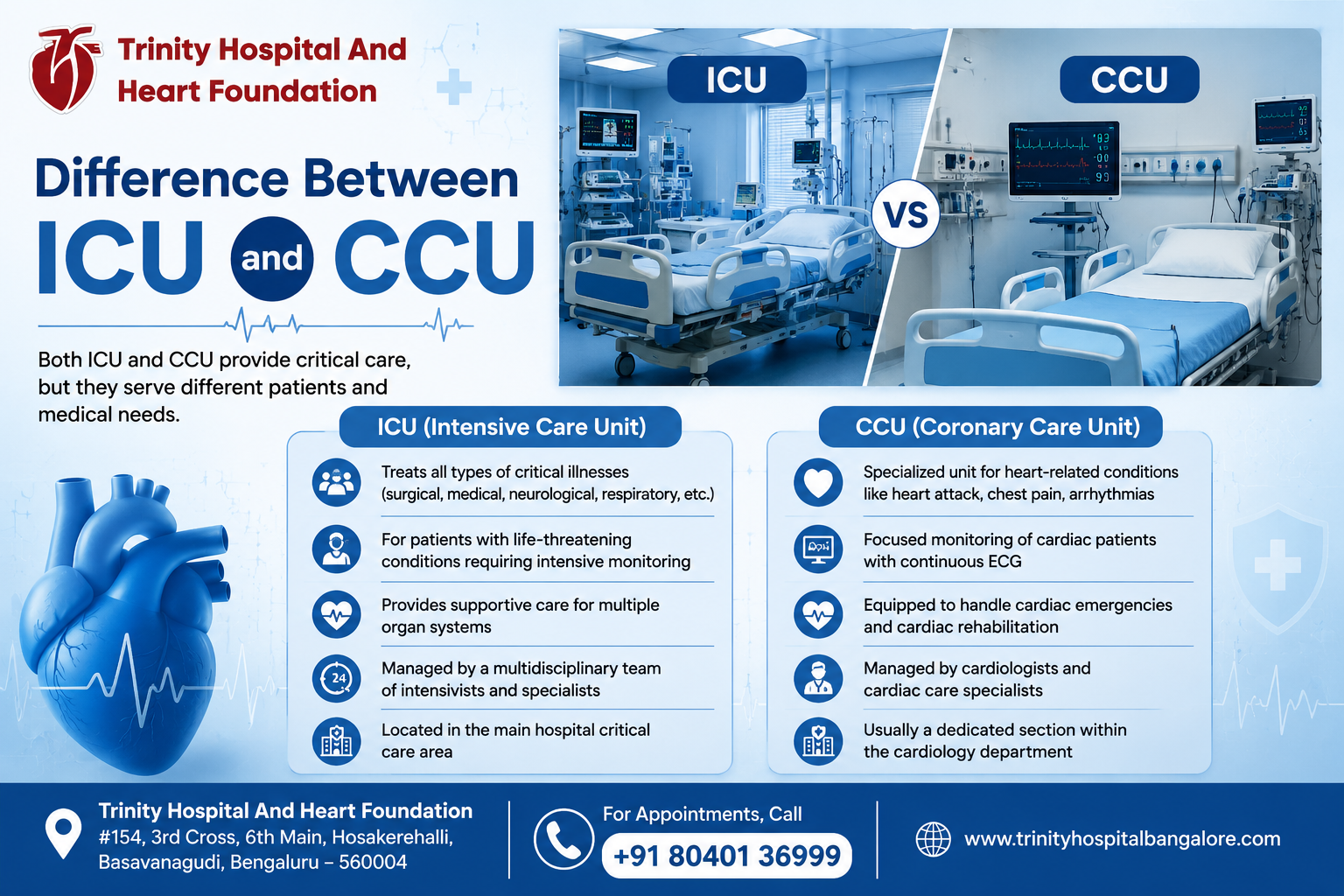
2. Understanding ICU and CCU
What Is ICU in Hospital?
What is ICU in hospital?
ICU stands for Intensive Care Unit. It is a specialised hospital area where patients with serious illnesses or conditions requiring continuous observation and advanced medical support are cared for.
The ICU may manage patients with problems involving one or more organs, including the heart, lungs, kidneys or brain.
Who Needs ICU Care?
Patients may require ICU care when they need:
- Continuous monitoring of vital signs
- Intensive treatment for a serious illness
- Support for breathing or other organ functions
- Close observation after major surgery
- Management of severe infections or complications
- Treatment following major trauma or other critical conditions
The decision to admit a patient is based on their clinical condition and the level of monitoring or support they require.
What Is a CCU?
CCU can refer to a Cardiac Care Unit or Coronary Care Unit, depending on the hospital.
A cardiac-focused CCU provides specialised monitoring and treatment for patients with significant cardiovascular conditions.
Patients in a CCU may require continuous observation of:
- Heart rhythm
- Heart rate
- Blood pressure
- Oxygen levels
- Other vital signs
Who May Need a CCU?
Depending on the hospital’s admission criteria, patients may be placed in a cardiac care setting because of conditions such as:
- Acute coronary syndromes
- Serious heart rhythm disturbances
- Acute heart failure
- Certain complications following cardiac procedures
- Other conditions requiring close cardiovascular monitoring
Importantly, being admitted to a CCU does not by itself predict a patient’s outcome. The reason for admission and the patient’s overall condition are what matter.
ICU vs CCU: What Is the Main Difference?
The simplest way to understand the CCU vs ICU distinction is to consider their primary focus.
| Feature | ICU | CCU |
| Full form | Intensive Care Unit | Cardiac Care Unit / Coronary Care Unit |
| Main focus | Serious illnesses requiring intensive care | Serious cardiac conditions requiring close monitoring |
| Patient group | Patients with critical medical, surgical or multi-organ conditions | Patients with significant cardiovascular conditions |
| Monitoring | Continuous monitoring of vital and organ functions | Continuous cardiac and vital-sign monitoring |
| Common specialists | Critical-care and multidisciplinary teams | Cardiology and critical-care teams, depending on the hospital |
| Treatment | Condition-specific intensive treatment and organ support | Intensive cardiovascular monitoring and treatment |
The distinction is not simply that an ICU is “more serious” than a CCU. A CCU can provide a very high level of care for patients with serious cardiac conditions.
What Is the Difference Between ICU and CCU in Hospital?
The difference between ICU and CCU in hospital can vary somewhat because hospitals organise critical-care services differently.
In general:
- ICU provides intensive care across a broad range of serious medical and surgical conditions.
- CCU focuses specifically on serious cardiovascular conditions when it is used as a cardiac or coronary care unit.
- Both may provide continuous monitoring and specialised nursing care.
- Both may use advanced equipment depending on the patient’s needs.
- A patient may be transferred between units as their condition changes.
Therefore, families should ask the treating team which type of CCU their hospital operates and why the patient has been admitted there.
Book Appointment
3. Types of Care Provided in ICU and CCU
ICU and CCU are not treatments themselves. They are specialised care environments where patients receive treatment appropriate to their condition.
ICU Treatment
ICU treatment may involve medical, surgical or supportive care depending on the patient’s illness.
Examples can include:
- Respiratory support when required
- Medication through intravenous routes
- Continuous monitoring
- Management of infections
- Organ-support therapies
- Postoperative intensive observation
- Management of complications
The exact treatment depends on the patient’s diagnosis.
Cardiac Care in a CCU
A cardiac care unit is designed for patients who require close cardiovascular observation.
Care may include:
- Continuous ECG monitoring
- Blood pressure monitoring
- Oxygen monitoring
- Cardiac medications
- Assessment of heart rhythm
- Management of acute cardiac conditions
- Observation following selected cardiac procedures
A coronary care unit is particularly associated with specialised care for patients with acute coronary conditions.
What Happens in ICU?
Families often search what happens in ICU because they want to understand what their relative’s day-to-day care may involve.
Although care differs according to the condition, ICU patients may receive:
- Continuous monitoring of vital signs
- Regular clinical assessments
- Medicines and fluids as prescribed
- Oxygen or respiratory support when required
- Laboratory investigations
- Imaging and other diagnostic tests
- Nursing care throughout the day and night
- Specialist consultations
Patients who require advanced organ support may have additional equipment and monitoring.
What Happens in CCU?
A CCU generally provides continuous cardiac monitoring for patients who need a higher level of cardiovascular observation.
Depending on the patient’s condition, the team may monitor:
- Heart rhythm
- Heart rate
- Blood pressure
- Oxygen saturation
- Symptoms
- Response to treatment
The patient may undergo ECGs, blood tests, echocardiography or other investigations when clinically appropriate.
What Is ICU Monitoring?
ICU monitoring involves continuous or frequent observation of important body functions.
Depending on the patient’s condition, monitoring can include:
- Heart rate
- Blood pressure
- Oxygen saturation
- Respiratory rate
- Temperature
- Heart rhythm
- Urine output
- Other organ-function measurements
The level of monitoring varies according to the patient’s medical needs.
ICU Patient Care: What Families Should Know
ICU patient care involves more than machines and monitoring.
The multidisciplinary team may include:
- Intensive-care physicians
- Specialist physicians
- Nurses
- Respiratory therapists where available
- Pharmacists
- Physiotherapists
- Dietitians
- Other healthcare professionals
Family communication is also an important part of hospital care. The treating team can explain the patient’s condition, investigations, treatment plan and expected next steps.
When Is CCU Required?
The question when is CCU required depends on the patient’s cardiovascular condition and the level of monitoring or treatment needed.
A patient may be considered for CCU care when they require close monitoring because of:
- Acute coronary syndromes
- Significant arrhythmias
- Acute heart failure
- Certain cardiac complications
- High-risk cardiac conditions
- Close observation after selected cardiac procedures
The decision is made by the treating medical team after assessing the patient’s clinical condition.
Reasons for ICU Admission
Common reasons for ICU admission can include serious conditions requiring intensive monitoring or organ support.
These may include:
- Severe infections
- Respiratory failure
- Major trauma
- Severe complications following surgery
- Significant organ dysfunction
- Serious neurological conditions
- Certain cardiac emergencies
- Other illnesses requiring intensive care
Not every patient with one of these conditions necessarily requires ICU admission. The clinical severity and need for specialised support determine the appropriate level of care.
ICU vs CCU vs ICCU: Are They the Same?
Not necessarily.
Hospitals may use different terminology:
- ICU: Intensive Care Unit
- CCU: Cardiac Care Unit or Coronary Care Unit
- ICCU: Intensive Cardiac Care Unit in some hospitals
- CICU: Cardiac Intensive Care Unit in some institutions
The terminology is not completely standardised across all hospitals.
This means a family should not assume that ICCU vs ICU or CCU vs ICU has exactly the same meaning everywhere. Ask the hospital team what the unit means within that particular hospital.
4. Cost and Related Considerations
The cost of ICU or CCU care cannot be determined from the unit name alone.
Hospital expenses can depend on:
- Patient’s medical condition
- Duration of admission
- Investigations required
- Medicines
- Monitoring requirements
- Respiratory or other organ support
- Procedures performed
- Specialist consultations
- Nursing requirements
- Room or bed category
- Treatment of complications
A patient requiring short-term observation may have very different costs from someone requiring prolonged intensive care.
Costs vary according to the patient’s condition, treatment requirements, hospital stay and services used. Patients and families should discuss an estimated treatment plan and billing details directly with the hospital.
5. Why Choose Trinity Hospital and Heart Foundation?
Trinity Hospital and Heart Foundation in Basavanagudi, Bangalore, provides cardiac and critical-care services as part of its hospital-based treatment pathway.
Cardiac evaluation and treatment may involve coordination between cardiologists, interventional cardiologists, cardiac surgeons, critical-care professionals, nurses and other healthcare staff.
Dr. BG Muralidhara
Dr. BG Muralidhara is associated with Trinity Hospital’s cardiology services as a Senior Interventional Cardiologist.
His clinical area includes interventional cardiology and evaluation of cardiovascular conditions. Depending on the patient’s condition, cardiac assessment may involve investigations such as ECG, echocardiography, coronary angiography or other appropriate tests.
The purpose of hospital-based evaluation is to identify the patient’s medical needs and determine the appropriate level of care rather than assuming that every patient requires ICU or CCU admission.
6. When Should You Speak With the Medical Team?
If a family member is admitted to an ICU or CCU, it is reasonable to ask the treating team:
- Why does the patient need this level of care?
- What condition is being treated?
- What monitoring is required?
- What treatment is currently being provided?
- How is the patient’s condition being assessed?
- What are the next expected steps?
- When might the patient be transferred to a regular ward or another care area?
Clear communication can help families understand the treatment pathway without relying on assumptions based only on the unit’s name.
CTA: Cardiac Care in Basavanagudi, Bangalore
If you or a family member has been advised to undergo cardiac evaluation, understanding the diagnosis and treatment options is an important part of informed healthcare.
Trinity Hospital and Heart Foundation, located in Basavanagudi, Bangalore, provides cardiology and cardiac-care services for patients requiring evaluation and treatment.
Phone: +91 80401 36999
For symptoms or medical concerns, consult a qualified healthcare professional rather than trying to determine whether ICU or CCU care is necessary yourself.
Book Appointment
Final Note
The difference between CCU and ICU is primarily related to the type of patient care and clinical focus. An ICU generally provides intensive care for a broad range of serious illnesses, while a cardiac-focused cardiac care unit or coronary care unit specialises in patients requiring intensive cardiovascular monitoring and treatment.
Terminology can vary between hospitals, particularly for terms such as CCU, ICCU and CICU. If your family member has been admitted to one of these units, the treating healthcare team is the best source of information about why that level of care has been recommended.
For patients in Basavanagudi and surrounding areas of Bangalore, Trinity Hospital and Heart Foundation provides hospital-based cardiology and cardiac-care services. Professional assessment and clear communication can help patients and families understand the next steps in care.
