

Bypass surgery is an established treatment for selected patients with significant coronary artery disease (CAD). It creates a new route for blood to reach the heart muscle beyond narrowed or blocked coronary arteries.
But having a blocked coronary artery does not automatically mean that bypass surgery is necessary. Doctors consider the location and severity of blockages, symptoms, heart function, other medical conditions, feasibility of angioplasty, and the expected benefits and risks of different treatment options.
Current guidelines emphasize individualized decision-making. The 2024 ESC guidance recommends considering coronary revascularization when symptoms remain despite appropriate medical treatment and/or when significant high-risk coronary disease is present. The most appropriate approach should be selected according to coronary anatomy, patient characteristics, procedural factors, preferences, and expected outcomes.
At Trinity Hospital & Heart Foundation, Basavanagudi, Bengaluru, patients with suspected or confirmed coronary artery disease can undergo comprehensive cardiac evaluation before a treatment strategy is recommended.
Patients often search what is bypass surgery when they or a family member has been diagnosed with coronary artery blockage.
Bypass surgery, also called Coronary Artery Bypass Grafting (CABG), is a surgical procedure that creates an alternative pathway for blood to flow around a significantly narrowed or blocked coronary artery.
During CABG, a healthy blood vessel is taken from another part of the body and connected to the coronary circulation beyond the blockage.
The new pathway allows blood to reach the heart muscle without having to pass through the severely narrowed section of the coronary artery.
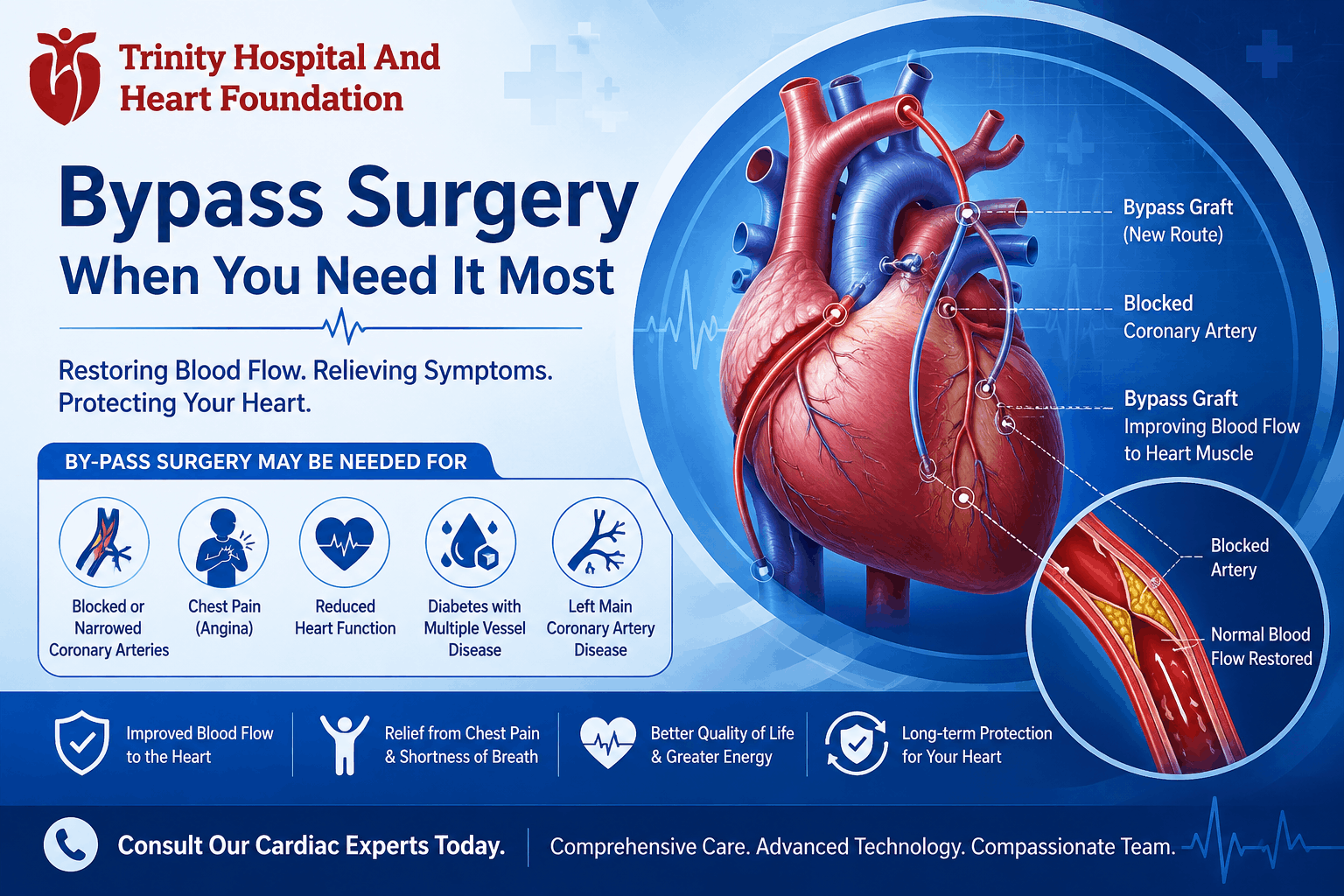
What is heart bypass surgery?
Heart bypass surgery is another commonly used term for CABG.
The procedure is performed to improve blood supply to the heart muscle in patients with coronary artery disease when revascularization is appropriate.
CABG may be considered when:
The specific indication varies between patients.
CABG stands for Coronary Artery Bypass Grafting.
It is a type of coronary revascularization surgery.
The surgeon uses a suitable blood vessel, such as an internal mammary artery or vein graft, to create a bypass around a blocked coronary artery.
The number of grafts depends on the number and location of coronary vessels that require treatment.
Therefore, the term CABG does not necessarily mean that a patient will require a particular number of bypasses.
The question when bypass surgery is needed cannot be answered using a single percentage of blockage.
Doctors look at the complete clinical picture.
CABG may be considered when a patient has:
Significant left main coronary artery disease is an important indication for revascularization. In suitable patients, surgical revascularization has a major role and may provide a survival advantage compared with medical therapy alone.
Patients with significant disease affecting multiple coronary arteries may be evaluated for CABG, particularly when the coronary anatomy is complex.
The 2024 ESC guidance notes that surgery is generally favored over PCI in patients with extensive disease, particularly when diabetes or reduced left ventricular ejection fraction is present.
If symptoms caused by myocardial ischemia continue despite appropriate medical treatment, coronary revascularization may be considered.
Patients with diabetes and multivessel coronary artery disease may benefit from a CABG-based treatment strategy when they are appropriate surgical candidates.
The ACC/AHA/SCAI guidance recommends a Heart Team approach for these decisions and gives CABG an important role in patients with diabetes and multivessel disease.
Patients with coronary artery disease and reduced left ventricular function may require assessment for surgical revascularization, particularly when ischemic cardiomyopathy is present.
The 2024 ESC guidance reports evidence supporting surgical revascularization for survival benefit in selected patients with reduced LV function and ischemic cardiomyopathy.
Coronary artery disease can cause symptoms when the heart muscle does not receive enough oxygen-rich blood.
Possible symptoms include:
Some patients may have significant coronary disease without obvious symptoms, particularly people with diabetes or other cardiovascular risk factors.
New, severe, or persistent chest pain—especially with breathlessness, sweating, fainting, or other acute symptoms—requires urgent medical evaluation.
Coronary arteries supply oxygen-rich blood to the heart muscle.
Over time, cholesterol-containing plaque can build up inside these arteries. This process can narrow the arterial passage and restrict blood flow.
When coronary artery disease becomes significant, patients may experience:
Depending on the location and complexity of the disease, treatment may include lifestyle modification, medications, angioplasty with stenting, CABG, or a combination of approaches.
Patients sometimes believe that a blockage above a certain percentage automatically means they need CABG.
In reality, the decision is more complex.
Doctors consider:
The 2024 ESC guidelines specifically emphasize selecting the revascularization strategy according to patient profile, coronary anatomy, procedural factors, preferences, and expected outcomes.
Triple-vessel disease means significant disease involving three major coronary artery territories.
Patients with triple-vessel disease require careful evaluation because the extent and complexity of coronary disease can influence the choice between CABG and PCI.
The ACC/AHA/SCAI guidance notes that surgical revascularization may be reasonable in selected patients with triple-vessel disease, particularly when the anatomy and clinical circumstances support surgery.
The 2024 ESC guidance also reports better long-term outcomes with CABG than PCI in selected patients with complex multivessel disease, particularly in the presence of diabetes.
Triple Bypass Surgery: What Does It Mean?
Triple bypass surgery means that three bypass grafts are created to improve blood flow to three areas supplied by significantly diseased coronary arteries.
It does not necessarily mean that exactly three arteries are completely blocked.
The number of bypass grafts is determined by the patient’s coronary anatomy and the vessels that require revascularization.
For example, a patient may require:
The final surgical plan is determined after detailed coronary imaging and Heart Team assessment.
CABG Heart Treatment and Coronary Revascularization
Patients may use the term CABG heart when searching for information about bypass treatment.
CABG is specifically a procedure for improving blood flow to the heart muscle by creating bypass pathways around diseased coronary arteries.
It does not directly repair the heart muscle itself.
The purpose is to restore adequate blood supply and, where appropriate, relieve ischemic symptoms and improve cardiovascular outcomes.
Tests Before Bypass Surgery
A thorough evaluation is required before deciding whether CABG is appropriate.
Depending on the patient’s condition, investigations may include:
An electrocardiogram records the electrical activity of the heart and can provide information about heart rhythm and previous or ongoing cardiac injury.
An echocardiogram assesses:
Coronary angiography provides detailed information about the location and severity of coronary artery blockages.
In selected patients, CT coronary angiography may help assess coronary anatomy.
Blood investigations may assess:
Additional testing may be recommended based on the patient’s medical history.
When Angioplasty May Not Be the Best Option
CABG and PCI are both forms of coronary revascularization, but they are not interchangeable for every patient.
Angioplasty with stenting may be appropriate for certain coronary lesions, while CABG may provide a better overall treatment strategy in selected patients with:
The Heart Team should compare the potential benefits and risks of each approach rather than automatically choosing one treatment.
The decision to perform coronary artery bypass surgery involves a detailed assessment of the patient’s heart and overall health.
The Heart Team may review:
When the optimal revascularization strategy is unclear, a multidisciplinary Heart Team approach with shared decision-making is recommended.
What Happens During Coronary Artery Bypass Surgery?
Coronary artery bypass surgery is performed under general anaesthesia.
During conventional CABG, the surgeon obtains one or more suitable blood vessels to use as grafts.
Depending on the surgical plan, grafts may come from:
The graft is then connected so that blood can flow around the diseased coronary artery.
The specific surgical technique depends on the patient’s anatomy and the surgeon’s assessment.
Open bypass surgery generally refers to conventional CABG performed through an incision that provides access to the heart, commonly involving a median sternotomy.
During conventional CABG, a heart-lung bypass machine may be used depending on the surgical technique.
There are also off-pump CABG approaches in selected patients.
The choice of technique is based on:
The objective is to achieve effective and durable revascularization safely.
The number of bypasses depends on the number of coronary territories requiring revascularization and the surgical plan.
Patients may undergo:
The number of grafts does not necessarily correspond directly to the number of completely blocked arteries.
A patient with complex coronary disease may require several grafts even when some arteries are narrowed rather than completely blocked.
One of the most important questions for patients is whether they need CABG or angioplasty.
PCI uses a catheter to open a narrowed coronary artery, usually followed by placement of a stent.
CABG creates a new pathway around the diseased portion of the coronary artery.
Neither treatment is universally better.
The appropriate option depends on:
For complex multivessel disease, particularly with diabetes, current evidence and guidelines often favor CABG when the patient is an appropriate surgical candidate.
For appropriately selected patients, bypass surgery can:
The benefits depend on the underlying coronary disease and the patient’s overall health.
CABG is not a cure for the underlying process of atherosclerosis. Long-term medical treatment and lifestyle modification remain important after surgery.
Like any major cardiac operation, CABG has potential complications.
Possible bypass surgery risks include:
The risk varies according to age, heart function, kidney and lung health, diabetes, urgency of surgery, and the complexity of coronary disease.
The surgical team should discuss the patient’s individual risk profile before the operation.
Not every patient with coronary artery disease is a candidate for bypass surgery.
The Heart Team may consider other approaches when:
Treatment decisions should be individualized.
Once CABG has been recommended, patients may undergo additional preparation.
This may include:
Patients should tell their healthcare team about all medications, allergies, previous surgeries, and existing medical conditions.
At Trinity Hospital & Heart Foundation, Basavanagudi, Bengaluru, patients can undergo comprehensive cardiac evaluation before a decision is made regarding coronary bypass surgery.
The cardiac care pathway may include:
The recommended approach is based on the patient’s coronary anatomy, symptoms, heart function, associated medical conditions, procedural risk, and long-term treatment goals.
For this page, the phrase “when bypass surgery is needed” should not be answered with a simplistic “X% blockage means CABG.” Current guidance supports a broader assessment of symptoms, coronary anatomy, high-risk disease, heart function, diabetes, procedural feasibility, and patient preferences.
Likewise, triple bypass surgery should be explained as three bypass grafts rather than implying that three arteries must be 100% blocked. This distinction makes the content more medically accurate and patient-first.
Recovery after bypass surgery takes place in stages. The exact recovery period varies depending on the patient’s age, overall health, heart function, number of bypasses performed, surgical technique, and whether complications occur.
After surgery, patients are initially monitored closely in the cardiac intensive care unit. The medical team monitors heart rhythm, blood pressure, breathing, kidney function, and other vital parameters.
As recovery progresses, patients are encouraged to gradually:
The healthcare team provides individualized guidance about activity levels and recovery.
Immediately after CABG, patients may spend time in a cardiac ICU before moving to a regular hospital room.
During this period, the medical team monitors:
Pain management is also an important part of recovery because patients need to breathe deeply and gradually become mobile.
The length of hospitalisation varies between patients and depends on the complexity of the procedure and postoperative recovery.
Cardiac rehabilitation can play an important role in recovery after bypass surgery.
A structured cardiac rehabilitation programme may include:
The goal is to help patients safely return to physical activity while reducing the risk of future cardiovascular events.
The timing and intensity of rehabilitation should be determined by the treating medical team.
Recovery does not end when the patient leaves the hospital.
Patients generally need to gradually increase their activity rather than immediately returning to their previous routine.
Your doctor may provide specific instructions regarding:
The appropriate timeline varies according to the patient’s recovery and type of surgery.
Bypass surgery improves blood flow through the grafted coronary pathways, but it does not eliminate the underlying process of coronary artery disease.
Long-term heart health therefore remains important after CABG.
Patients should focus on:
These measures can help reduce cardiovascular risk and protect overall heart health.
Bypass grafts can develop narrowing or blockage over time, and the original coronary artery disease process can continue.
The likelihood depends on several factors, including:
This is why CABG should be considered part of a broader long-term cardiovascular treatment plan rather than a permanent cure for atherosclerosis.
Patients recovering from CABG should follow their discharge instructions and contact their healthcare team if they experience concerning symptoms.
These may include:
Severe or sudden symptoms may require urgent medical attention.
Regular follow-up helps doctors assess recovery and manage cardiovascular risk factors.
Follow-up may include:
Additional investigations may be recommended if symptoms return or new concerns develop.
The longevity of a bypass graft varies depending on the type of graft and the patient’s cardiovascular risk factors.
Arterial grafts, particularly the internal mammary artery, generally demonstrate excellent long-term durability. Vein grafts can also provide effective revascularization but may develop narrowing over time.
Patients can help protect their grafts by controlling cardiovascular risk factors and following their prescribed treatment plan.
Areas We Serve
Patients seeking evaluation for bypass surgery at Trinity Hospital may travel from several areas of Bengaluru, including:
Trinity Hospital & Heart Foundation is located in Basavanagudi, Bengaluru and can be accessed through major roads and public transportation.
Nearby landmarks include:
Patients can use Metro services, BMTC buses, taxis, or private vehicles depending on their location.
Choosing between CABG, angioplasty, medical management, or another revascularization strategy requires detailed assessment.
At Trinity Hospital & Heart Foundation, patients can undergo comprehensive evaluation for coronary artery disease and assessment for coronary artery bypass surgery.
The cardiac care pathway may include:
The final treatment decision is based on coronary anatomy, symptoms, heart function, associated conditions, surgical risk, and the patient’s treatment goals.
If you have been diagnosed with significant coronary artery disease, recurrent chest pain, multivessel disease, or have been advised to consider bypass surgery, a detailed cardiac evaluation can help determine the most appropriate treatment.
At Trinity Hospital & Heart Foundation, Basavanagudi, the cardiac team can evaluate whether CABG, angioplasty and stenting, medical treatment, or another approach is appropriate for your condition.
Conclusion
Understanding when bypass surgery is needed can help patients make informed decisions after being diagnosed with coronary artery disease. CABG is not automatically required for every coronary blockage. Instead, doctors consider the location and complexity of disease, symptoms, heart function, diabetes and other medical conditions, surgical risk, and the potential benefits of different revascularization strategies.
Coronary artery bypass surgery can be an important treatment for appropriately selected patients, including some patients with significant left-main disease, complex multivessel coronary disease, diabetes with multivessel disease, or persistent symptoms despite medical treatment.
At Trinity Hospital & Heart Foundation, Basavanagudi, Bengaluru, patients can undergo detailed cardiac assessment and individualized treatment planning to determine whether CABG, angioplasty, medical management, or another treatment approach is appropriate.
 24 Hour Emergency Aid