

When aortic valve replacement is recommended for severe aortic stenosis, patients and families often want to understand the difference between TAVI surgery and traditional open-heart valve replacement. Both approaches can replace a diseased aortic valve, but they differ in how the new valve is delivered, recovery, risks, and which patients may be suitable.
TAVI heart procedure, also called TAVR (Transcatheter Aortic Valve Replacement), uses a catheter to position a replacement valve inside the diseased aortic valve. Traditional surgical aortic valve replacement (SAVR) involves cardiac surgery to replace the valve.
The choice is not simply between a “less invasive” and a “more invasive” procedure. Doctors consider the severity of aortic stenosis, age, life expectancy, valve anatomy, surgical risk, vascular access, other heart conditions, and the patient’s preferences. The ACC/AHA guideline recommends shared decision-making with a multidisciplinary Heart Valve Team when valve replacement is being considered.
At Trinity Hospital and Heart Foundation, Basavanagudi, Bengaluru, TAVR is listed among the cardiac services, alongside surgical valve replacement and other cardiac interventions.
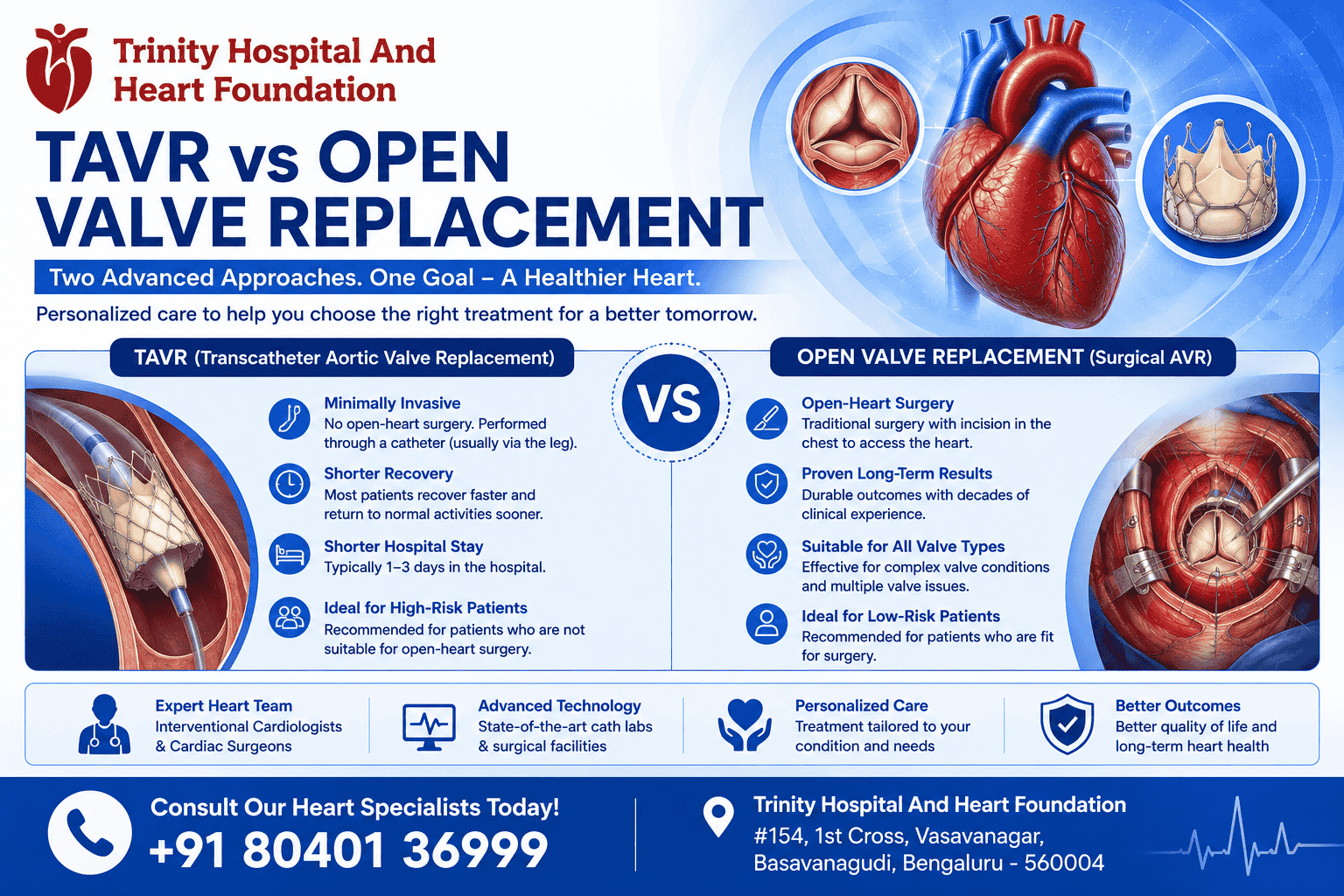
TAVI surgery and TAVR generally refer to the same type of treatment. TAVI stands for Transcatheter Aortic Valve Implantation, while TAVR stands for Transcatheter Aortic Valve Replacement.
In a TAVR heart valve procedure, a replacement valve is delivered through a catheter and positioned within the diseased aortic valve.
Unlike conventional surgery, TAVR does not require traditional open-heart access to replace the valve.
At Trinity Hospital, the published TAVR information describes the procedure as a minimally invasive approach for suitable patients with aortic stenosis and states that the replacement valve is delivered through a catheter-based approach.
The objectives of TAVI surgery include:
TAVR is not suitable for every person with aortic stenosis. Valve anatomy and vascular access need to be assessed before treatment.
Aortic valve replacement through surgery is commonly called surgical aortic valve replacement or SAVR.
During surgical replacement, the diseased valve is removed or surgically addressed and replaced with a prosthetic valve. This is performed through cardiac surgery rather than through a catheter-only approach.
Surgical replacement may be considered when:
The ACC/AHA guideline recommends considering age, life expectancy, anatomy, surgical risk, valve durability and patient preferences when choosing between TAVI and SAVR.
| Feature | TAVR / TAVI | Surgical Aortic Valve Replacement |
| Approach | Catheter-based | Open cardiac surgery |
| Chest opening | Does not require traditional open-heart access | Requires surgical access |
| Valve delivery | Replacement valve delivered through a catheter | Valve implanted during surgery |
| Recovery | Often shorter than surgical replacement, depending on the patient | Usually longer |
| Suitability | Depends on anatomy, age, risk and access vessels | Suitable for many patients based on surgical assessment |
| Other cardiac surgery | Limited ability to address other surgical conditions simultaneously | Can be combined with other cardiac procedures |
| Decision factors | Anatomy, age, life expectancy, risk and preferences | Same factors, with emphasis on surgical suitability and valve durability |
Neither treatment is universally better. The appropriate approach is determined after detailed evaluation.
The decision should be individualized rather than based on age alone.
According to the ACC/AHA recommendations, for patients with severe aortic stenosis who require valve replacement:
These are guideline recommendations, not rules that determine treatment for every individual. Valve anatomy, surgical risk, life expectancy, durability considerations and patient preferences remain important.
A TAVI heart procedure may be considered when a patient has an indication for aortic valve replacement and the anatomy and clinical profile are appropriate.
Potential considerations include:
The ACC/AHA guideline recommends multidisciplinary evaluation for severe valvular heart disease being considered for intervention.
At Trinity Hospital, the published TAVR service information states that Dr. B. G. Muralidhara evaluates patients based on valve anatomy, overall health and individual clinical factors.
Traditional surgical aortic valve replacement may be preferred when surgery offers important advantages.
This can include patients who:
For example, a patient who requires another cardiac operation at the same time may benefit from a surgical approach that addresses multiple problems during one operation.
Before deciding between TAVR aortic replacement and surgery, doctors need detailed information about the valve and heart.
Evaluation may include:
The ACC/AHA guideline recommends correlating the patient’s history and examination with non-invasive testing. If findings do not agree, additional non-invasive or invasive testing may be needed to determine the optimal treatment strategy.
Trinity Hospital lists ECG, 2D echocardiography, CT coronary angiography and other cardiac diagnostic services within its cardiology pathway.
A TAVI operation heart procedure uses catheter-based technology rather than traditional open-heart surgery.
At Trinity Hospital, the published procedure information describes:
The hospital states that TAVR procedures are performed in a specialized hybrid cardiac catheterization laboratory with advanced imaging and monitoring capabilities.
The exact access route and procedural plan depend on the patient’s anatomy.
One of the main questions patients have is about recovery.
The hospital’s current TAVR page states that many patients recover faster than after traditional open-heart surgery, although recovery varies between individuals. It describes recovery as including:
Recovery following open valve replacement generally involves a longer period of hospital and home recovery. Physical activity is increased gradually according to the cardiac team’s instructions.
Patients may require:
Recovery varies depending on age, general health, the type of surgery and whether additional procedures were performed.
What About Recovery After Heart Bypass?
Recovery after heart bypass is different from recovery after isolated TAVR or isolated valve replacement.
Bypass surgery, or CABG, treats blocked coronary arteries rather than replacing a diseased aortic valve. Some patients with valve disease may also have significant coronary artery disease requiring treatment.
When both conditions require intervention, the cardiac team evaluates whether combined surgical treatment is appropriate.
Therefore, bypass surgery should not be considered an alternative to TAVR simply because both are cardiac procedures. They address different problems.
AVR replacement is a broad term referring to aortic valve replacement. It can include:
TAVR is therefore a form of aortic valve replacement, but it is performed using a catheter-based approach.
The term atrial valve replacement is sometimes used in online searches, but it is not the standard medical term for replacement of the aortic valve. The relevant term for this topic is aortic valve replacement.
No.
Aorta replacement surgery and TAVR treat different conditions.
The aortic valve and aorta are anatomically related but are not the same structure.
This distinction is important when researching heart procedures online.
Both TAVR and surgery have potential risks. The type and likelihood of complications depend on the patient’s health and anatomy.
Potential TAVR complications can include:
Surgical valve replacement may involve risks such as:
A cardiac team should explain the patient’s individual risk profile before treatment.
Valve durability is an important part of the TAVR-versus-surgery discussion, particularly for younger patients with a long expected life expectancy.
The choice of valve and procedure should consider:
This is one reason younger patients may be more likely to have SAVR considered, while TAVR may be particularly attractive for appropriately selected older or higher-risk patients. The ACC/AHA guideline specifically incorporates age, life expectancy and valve durability into the choice between SAVR and TAVI.
Trinity Hospital and Heart Foundation lists Transcatheter Aortic Valve Replacement in Basavanagudi Bangalore among its cardiac services.
The hospital’s published TAVR information states that its facility includes a hybrid cardiac catheterization laboratory, advanced imaging systems, continuous procedural monitoring and intensive cardiac care for post-procedure monitoring.
The hospital also lists:
Patients can be evaluated to determine whether TAVR, surgical valve replacement or continued medical monitoring is appropriate.
Dr. B. G. Muralidhara is listed by Trinity Hospital as a Senior Interventional Cardiologist.
His published profile lists:
The profile states that he has more than three decades of experience in cardiology and reports experience with more than 10,000 angioplasties, 60,000 coronary angiograms and 2,000 pacemaker implantations.
His listed areas of expertise include:
Trinity Hospital’s TAVR page specifically states that Dr. Muralidhara evaluates patients for TAVR suitability based on valve anatomy, overall health and individual clinical factors.
There is no single procedure that is right for everyone with severe aortic stenosis.
The decision between TAVI surgery and surgical aortic valve replacement should consider:
The ACC/AHA guideline recommends multidisciplinary evaluation and shared decision-making for severe valve disease requiring intervention.
The cost of TAVI surgery or surgical valve replacement varies between patients.
Factors may include:
A treatment estimate should be discussed after clinical evaluation. The cost should not be the only factor used to decide between TAVR and surgery; medical suitability and long-term outcomes are important considerations.
A cardiac evaluation is appropriate if you have symptoms that may be related to aortic valve disease, such as:
Symptoms alone do not establish that TAVR or surgery is necessary. Proper cardiac assessment is required. Trinity Hospital similarly advises professional evaluation for persistent breathlessness, chest discomfort, dizziness, fainting or unexplained fatigue.
 24 Hour Emergency Aid