

If you have blocked coronary arteries, your cardiologist may recommend either angioplasty or bypass surgery depending on the number of blockages, severity of heart disease, overall heart function, and your medical history. Angioplasty is a minimally invasive procedure that uses a balloon and stent to open blocked arteries, while bypass surgery creates a new route for blood flow around severely blocked arteries. Understanding the difference between angioplasty and bypass surgery can help patients make informed treatment decisions with their heart specialist.
Coronary artery disease occurs when fatty deposits (plaque) narrow or block the arteries supplying blood to the heart muscle. Reduced blood flow can cause chest pain, shortness of breath, fatigue, or even a heart attack.
Depending on the location and complexity of the blockage, specialists may recommend:
At Trinity Hospital Bangalore, treatment recommendations are based on detailed cardiac evaluation, angiography findings, patient age, diabetes status, and overall cardiovascular health.
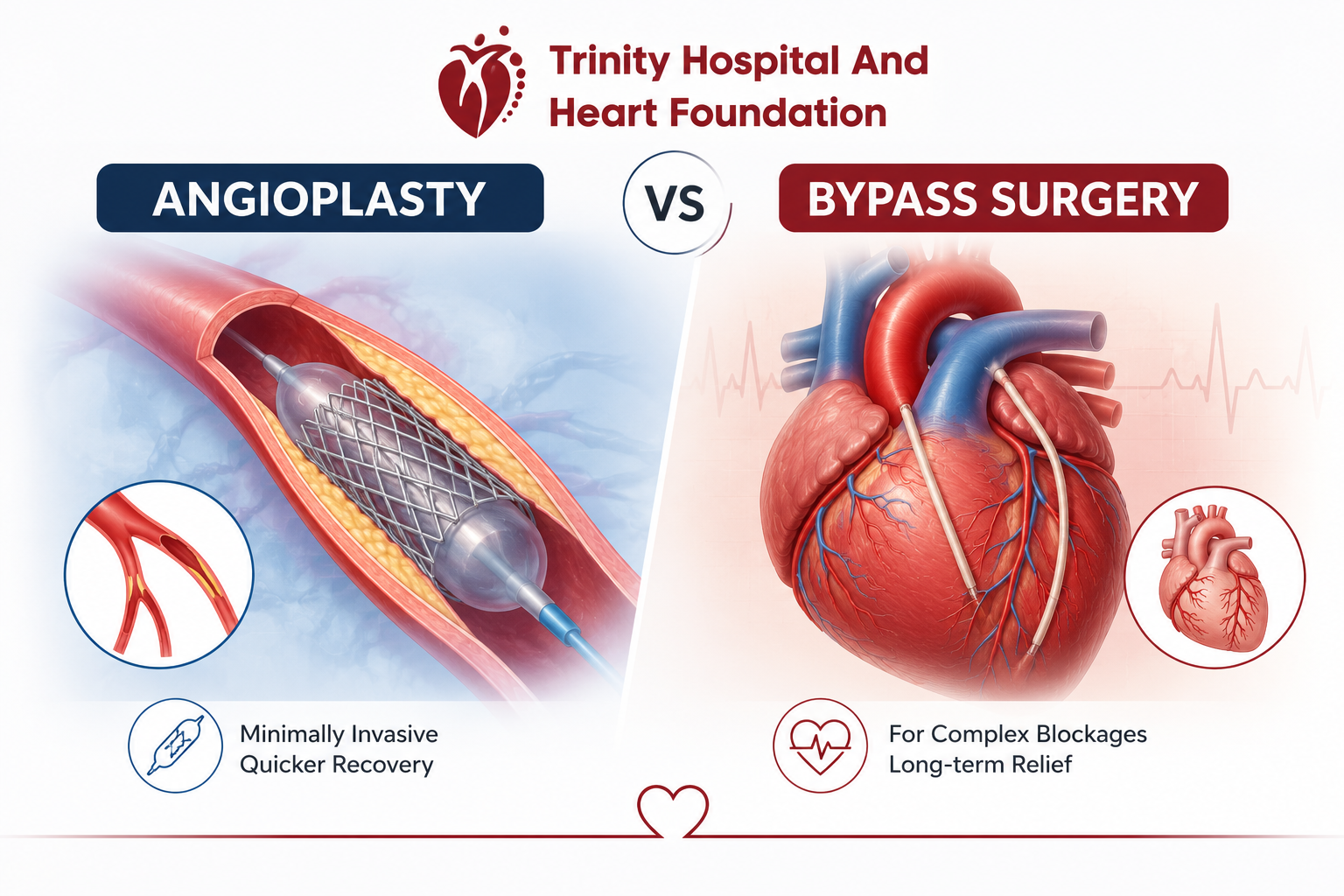
Angioplasty is a minimally invasive procedure performed by an interventional cardiologist to restore blood flow through narrowed or blocked coronary arteries.
During the procedure:
Angioplasty may be recommended for patients with:
Many patients ask, “Is angioplasty safe?”
For suitable candidates, angioplasty is considered a commonly performed cardiac procedure with established safety protocols and shorter recovery times compared to open-heart surgery.
Coronary Artery Bypass Graft (CABG), commonly known as bypass surgery, is an open-heart surgical procedure used to improve blood flow to the heart.
During bypass surgery:
Bypass surgery is generally recommended for patients with complex or multiple coronary artery blockages.
| Factor | Angioplasty | Bypass Surgery |
| Procedure Type | Minimally invasive | Open-heart surgery |
| Hospital Stay | Usually 1–3 days | Usually 5–10 days |
| Recovery Time | Faster | Longer |
| Anaesthesia | Local with sedation | General anaesthesia |
| Suitable For | Single or limited blockages | Multiple or complex blockages |
| Scarring | Minimal | Surgical chest incision |
| Risk Profile | Lower procedural trauma | More extensive surgery |
| Long-Term Outcomes | Excellent in selected patients | Often preferred for complex disease |
There is no single treatment that is best for every patient.
The decision should always be individualized based on diagnostic findings and cardiology consultation.
Many patients compare bypass surgery vs stent treatment.
A stent is part of angioplasty and helps keep arteries open after the blockage is widened.
The best option depends on the patient’s heart condition and treatment goals.
One of the most common questions patients ask is whether angioplasty is safe.
Angioplasty has become a widely performed cardiac procedure globally and is considered an established treatment option when performed by experienced interventional cardiologists in appropriately selected patients.
Potential risks include:
Most patients experience significant symptom relief and improved blood flow following successful angioplasty.
| Factor | Angioplasty | Bypass Surgery (CABG) |
| Procedure Type | Minimally invasive catheter-based procedure performed through the wrist or groin artery. | Open-heart surgery that creates a new route for blood flow around blocked arteries. |
| Purpose | Opens narrowed or blocked coronary arteries to restore blood flow. | Bypasses severely blocked arteries using healthy blood vessels from another part of the body. |
| Suitable For | Often recommended for single or limited coronary artery blockages. | Commonly recommended for multiple or complex blockages and advanced coronary artery disease. |
| Hospital Stay | Usually 1–3 days depending on the patient’s condition and recovery. | Typically 5–10 days, depending on surgical recovery and overall health. |
| Recovery Time | Most patients return to routine activities within a few days to a few weeks. | Recovery may take several weeks to a few months due to the surgical nature of the procedure. |
| Anaesthesia | Usually performed under local anaesthesia with sedation. | Requires general anaesthesia and a surgical operating room setting. |
| Scarring | Minimal scarring due to a small catheter entry point. | Involves a chest incision, resulting in a larger surgical scar. |
| Long-Term Outcomes | Effective for many patients with suitable coronary artery disease and may involve stent placement. | Often preferred for extensive coronary artery disease and may reduce the need for future procedures in selected patients. |
The choice between angioplasty and bypass surgery depends on several factors, including the number of blocked arteries, severity of coronary artery disease, heart function, age, overall health, and angiography findings. A cardiologist and cardiac care team will recommend the most appropriate treatment after a comprehensive evaluation.
Most patients:
Recovery may involve:
Factors considered include:
A multidisciplinary heart team approach helps determine the most appropriate treatment plan.
Senior Interventional Cardiologist & Chief of Cardiology
Dr. B. G. Muralidhara is a highly experienced interventional cardiologist with more than 30 years of expertise in diagnosing and treating complex heart conditions. He leads the cardiology team at Trinity Hospital & Heart Foundation, Basavanagudi, and is known for his extensive experience in coronary interventions, preventive cardiology, and emergency cardiac care.
| Decision Factor | Angioplasty May Be Recommended | Bypass Surgery May Be Recommended |
| Number of Blocked Arteries | One or two blocked coronary arteries that can be treated with stents. | Multiple blocked arteries, especially when several major vessels are involved. |
| Severity of Blockage | Localized narrowing or blockage that can be opened using a balloon and stent. | Extensive or complex blockages that may not be suitable for stent placement alone. |
| Location of Blockage | Blockages located in arteries that are accessible through catheter-based treatment. | Critical blockages involving the left main coronary artery or multiple major vessels. |
| Heart Attack (Emergency Cases) | Often the preferred emergency treatment to quickly restore blood flow during a heart attack. | Usually not the first choice in an acute emergency unless surgery is specifically required. |
| Coronary Artery Disease Complexity | Suitable for less complex coronary artery disease. | Often recommended for advanced or diffuse coronary artery disease. |
| Diabetes and Heart Disease | May be suitable in selected diabetic patients with limited disease. | Frequently preferred for diabetic patients with multiple severe blockages due to better long-term outcomes in certain cases. |
| Previous Stent Failure | Additional angioplasty may be considered in some situations. | May be recommended when recurrent blockages occur despite previous angioplasty or stent placement. |
| Patient’s Overall Health | Preferred when a minimally invasive procedure is appropriate and surgical risk is higher. | Recommended when the expected long-term benefits outweigh surgical risks. |
| Recovery Considerations | Suitable for patients who may benefit from shorter hospital stays and faster recovery. | Considered when more extensive treatment is needed despite a longer recovery period. |
| Angiography Findings | Recommended when coronary angiography shows blockages that can be effectively treated with stents. | Recommended when angiography reveals complex, multiple, or extensive arterial disease. |
The decision between angioplasty and bypass surgery is based on several factors, including:
At Trinity Hospital, treatment recommendations are made after a detailed cardiac evaluation and review of coronary angiography results to ensure each patient receives the most appropriate and personalized heart care.
Patients receive detailed assessments using advanced cardiac diagnostics and imaging.
Every case is reviewed individually to determine whether angioplasty, bypass surgery, or medical management is most suitable.
Rapid evaluation and treatment pathways are available for patients with acute cardiac symptoms.
From diagnosis and treatment to recovery and long-term heart health management, patients receive coordinated cardiac care.
 24 Hour Emergency Aid