

MICS vs Open Heart Surgery: Understanding the Difference
When cardiac surgery is recommended, patients often wonder whether a minimally invasive approach can be used instead of conventional open-heart surgery. MICS, or minimally invasive cardiac surgery, uses smaller surgical incisions and specialized instruments for selected heart procedures. Conventional open-heart surgery uses a larger surgical access point and may provide the surgeon with broader exposure of the heart.
The choice between MICS and conventional surgery is not simply about choosing the procedure with the smallest incision. It depends on the cardiac condition, anatomy, type of surgery required, previous operations, overall health, and the experience and facilities available at the treating centre.
Patients researching coronary artery disease treatments may encounter MICS while looking for options for coronary artery bypass surgery. However, MICS is an approach to surgery, while angioplasty, PCI and bypass surgery are different treatment strategies for coronary artery disease.
Understanding these differences can help patients have a more informed discussion with their cardiologist and cardiac surgeon.
At Trinity Hospital and Heart Foundation in Basavanagudi, Bengaluru, cardiac evaluation involves diagnostic cardiology, interventional cardiology and cardiac surgical services. Treatment planning can therefore be based on the patient’s specific cardiac condition rather than on a single procedure being suitable for everyone.
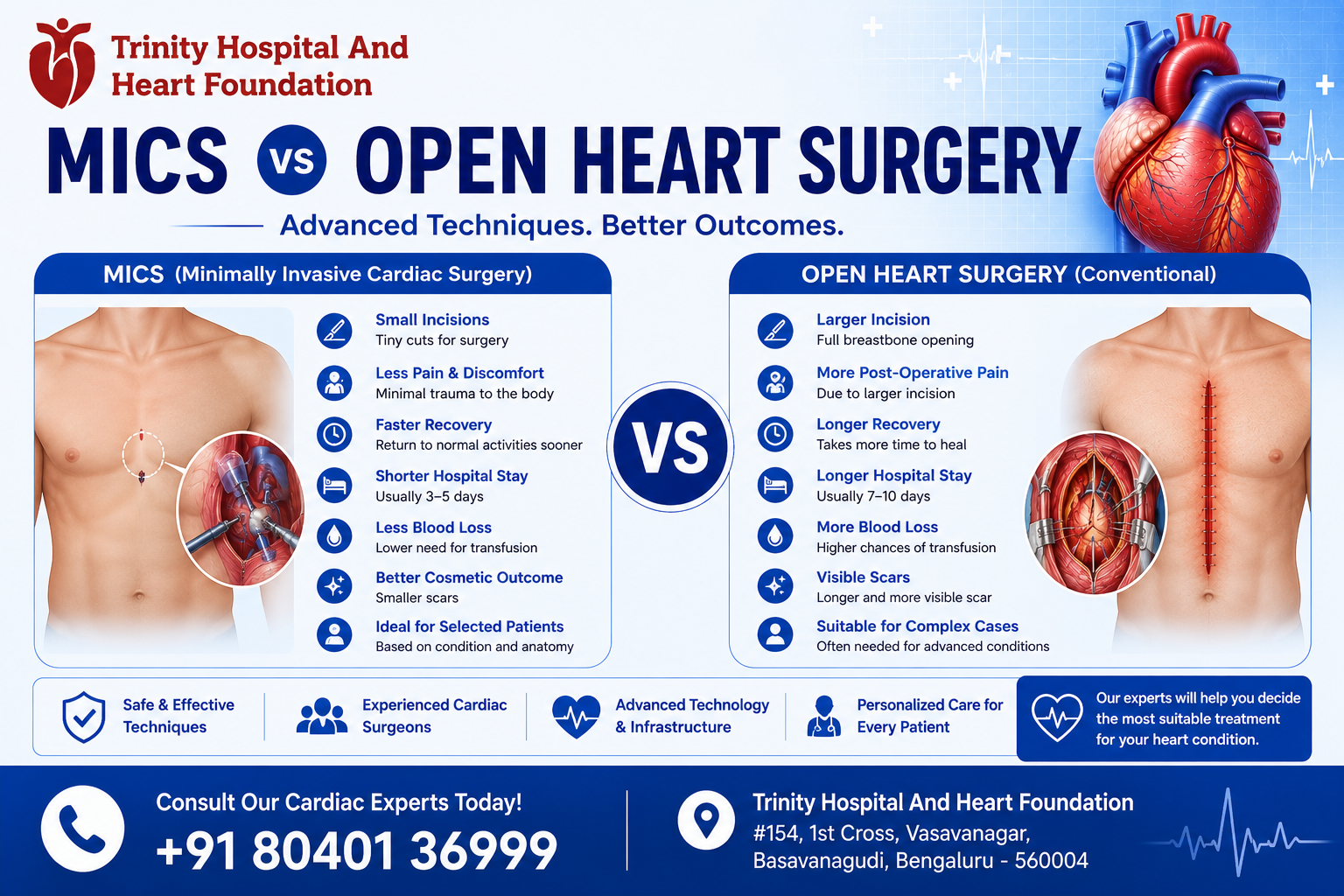
MICS stands for Minimally Invasive Cardiac Surgery.
Instead of the conventional large surgical access used in many open-heart operations, MICS uses smaller incisions and specialized surgical techniques for selected procedures.
Depending on the operation, minimally invasive cardiac surgery may involve:
MICS is not one single operation. It is an approach that can be used for certain cardiac procedures when the patient’s anatomy and clinical situation make it appropriate.
The exact procedures available through minimally invasive approaches vary between hospitals and surgeons. Depending on the patient’s condition, minimally invasive techniques may be considered for selected:
Not every cardiac operation can be safely performed through a minimally invasive approach.
“Open heart surgery” is a commonly used term for cardiac operations that require conventional surgical access to the chest.
For some operations, the surgeon may need broader access to the heart and major blood vessels. A median sternotomy, which involves opening the breastbone, is one conventional surgical approach.
Depending on the procedure, open surgery may be used for:
Open surgery remains an important treatment option when it provides the most appropriate and safe access for a particular cardiac condition.
| Feature | MICS | Conventional Open Heart Surgery |
| Surgical access | Smaller or alternative incisions | Conventional larger surgical access |
| Surgical exposure | More limited and specialized | Broad surgical exposure |
| Incision size | Generally smaller | Generally larger |
| Suitability | Selected patients and procedures | Broad range of complex cardiac procedures |
| Recovery | May be shorter for suitable patients | Usually involves a longer recovery |
| Scarring | May be less noticeable | Usually more prominent |
| Technical requirements | Requires specialized equipment and expertise | Established conventional surgical approach |
| Decision | Depends on anatomy and procedure | Used when conventional access is clinically appropriate |
The table provides a general comparison. Individual outcomes and recovery vary from patient to patient.
There is no single answer.
MICS may offer advantages for appropriately selected patients, but it is not automatically superior to conventional surgery.
Doctors consider:
The primary goal is to perform the necessary cardiac treatment safely and effectively. The size of the incision is only one part of the decision.
Patients with coronary artery disease may encounter several treatment options, including lifestyle and medical management, angioplasty, stent placement and coronary artery bypass surgery.
These treatments should not be considered interchangeable.
Angioplasty is a catheter-based treatment that opens a narrowed or blocked coronary artery. It may also be called percutaneous transluminal angioplasty, PTCA or PCI.
A balloon may be used to widen the narrowed section, followed in many cases by stent placement.
PTCA with stent combines balloon angioplasty with placement of a coronary stent to help maintain the treated artery’s opening.
A CABG procedure creates a new route for blood to flow around severely narrowed or blocked coronary arteries.
MICS may be used as a surgical approach for selected coronary bypass procedures. However, not every patient requiring bypass surgery is suitable for a minimally invasive approach.
For selected patients, coronary bypass surgery may be performed through a minimally invasive approach.
The potential advantages of minimally invasive bypass surgery may include:
However, these benefits must be balanced against the complexity of the coronary disease and the technical requirements of the operation.
Conventional bypass surgery may be preferred when extensive access is required or when the patient’s coronary anatomy makes a minimally invasive approach unsuitable.
The decision should be made after detailed coronary and surgical assessment.
Conventional surgery may be considered when it provides better or safer access to the structures requiring treatment.
This may be relevant when:
Choosing conventional surgery does not mean that the treatment is inferior. In some situations, it may be the most appropriate surgical approach.
Common coronary artery disease symptoms may include:
Some people may have coronary artery disease without obvious symptoms.
If symptoms suggest possible coronary disease, a cardiologist may recommend appropriate investigations rather than relying on symptoms alone.
Evaluation may involve different tests depending on the patient’s symptoms and risk profile.
These can include:
A coronary angiogram can provide detailed information about the location and severity of coronary artery blockages when invasive coronary imaging is clinically indicated.
The results help doctors determine whether coronary artery disease treatments such as medication, angioplasty or CABG should be considered.
Recovery depends on the procedure rather than simply whether the surgery is labelled “minimally invasive.”
Patients undergoing suitable minimally invasive procedures may experience:
The recovery period varies according to the operation and the patient’s overall health.
Recovery after conventional cardiac surgery may involve:
Patients should follow the individual recovery plan provided by their surgical team.
MICS is still cardiac surgery and therefore carries potential surgical risks.
Possible complications may include:
The risks vary according to the procedure, patient’s health and surgical complexity.
A smaller incision does not mean that the operation carries no risk.
Conventional cardiac surgery also carries potential risks.
These may include:
The surgeon should explain the expected benefits and potential risks before treatment.
No.
This is an important distinction for patients researching treatment options online.
MICS describes a minimally invasive surgical approach.
Angioplasty is a catheter-based treatment that opens a narrowed coronary artery.
PTCA and percutaneous transluminal angioplasty refer to balloon-based coronary intervention.
CABG is a surgical treatment that creates a new blood-flow pathway around blocked coronary arteries.
Therefore:
MICS = surgical approach
Angioplasty/PTCA = catheter-based treatment
CABG = coronary bypass operation
A patient may be evaluated for either PCI or bypass surgery depending on the pattern of coronary disease.
Patients sometimes search for MICS vs CABG, but these terms describe different things.
CABG tells you what treatment is being performed: coronary artery bypass grafting.
MICS tells you how the surgical procedure may be accessed: through a minimally invasive approach.
Therefore, a patient can potentially have a minimally invasive CABG procedure when the anatomy and surgical circumstances are appropriate.
The availability and suitability of a minimally invasive approach must be assessed individually.
Before recommending MICS, the cardiac team may consider:
Imaging and diagnostic investigations help the team understand the patient’s anatomy before selecting a surgical approach.
Trinity Hospital and Heart Foundation in Basavanagudi, Bengaluru, provides cardiac diagnostic, interventional and surgical services.
Its cardiology services include investigations and treatments such as:
This range of services allows patients to undergo cardiac evaluation before an appropriate treatment pathway is selected.
Dr. B. G. Muralidhara is listed by Trinity Hospital as a Senior Interventional Cardiologist.
His published profile lists:
The hospital profile states that he has more than three decades of experience in cardiology and reports experience with more than 10,000 angioplasties, 60,000 coronary angiograms and 2,000 pacemaker implantations.
His listed areas of expertise include:
The cost of cardiac surgery varies according to the procedure and patient’s clinical condition.
Factors that may influence treatment costs include:
MICS should not be selected solely because it may involve a smaller incision or potentially shorter recovery. Clinical suitability should remain the primary consideration.
Patients should discuss the expected treatment plan and associated costs directly with the hospital after evaluation.
Consider discussing cardiac symptoms or risk factors with a qualified cardiologist if you experience:
Chest pain that is severe, persistent or accompanied by significant breathlessness, fainting or other concerning symptoms requires prompt medical assessment.
Final Note
MICS vs open heart surgery is not a choice that can be made based only on incision size or recovery time. The right surgical approach depends on the cardiac condition, anatomy and overall health of the patient.
For people with coronary artery disease, the treatment decision may involve medication, angioplasty, PTCA with stent, CABG or another cardiac intervention. A detailed cardiac evaluation helps determine which treatment is appropriate.
Patients in Basavanagudi and surrounding areas of Bengaluru can consult the cardiology team at Trinity Hospital for evaluation and individualized treatment planning.
 24 Hour Emergency Aid