

When a person is diagnosed with blocked coronary arteries, one of the most important questions is whether bypass surgery or angioplasty is more appropriate. Both are established treatments for coronary artery disease, but they work in different ways and are suitable for different clinical situations.
Coronary artery bypass graft surgery, commonly called CABG, creates a new route for blood to flow around significantly narrowed or blocked coronary arteries. Angioplasty, also known as PCI or percutaneous transluminal angioplasty, uses a catheter to open a narrowed coronary artery, usually with balloon treatment and placement of a stent.
The decision between CABG and PCI should not be based only on the number of blockages. Doctors consider the location and complexity of coronary disease, symptoms, heart function, diabetes, surgical risk, overall health, technical feasibility and patient preferences. When the optimal strategy is unclear, current ACC/AHA/SCAI guidance recommends a multidisciplinary Heart Team approach and shared decision-making.
At Trinity Hospital and Heart Foundation, Basavanagudi, Bengaluru, the cardiac care pathway includes coronary angiography, coronary angioplasty and stenting, complex angioplasty, and Coronary Artery Bypass Grafting (CABG).
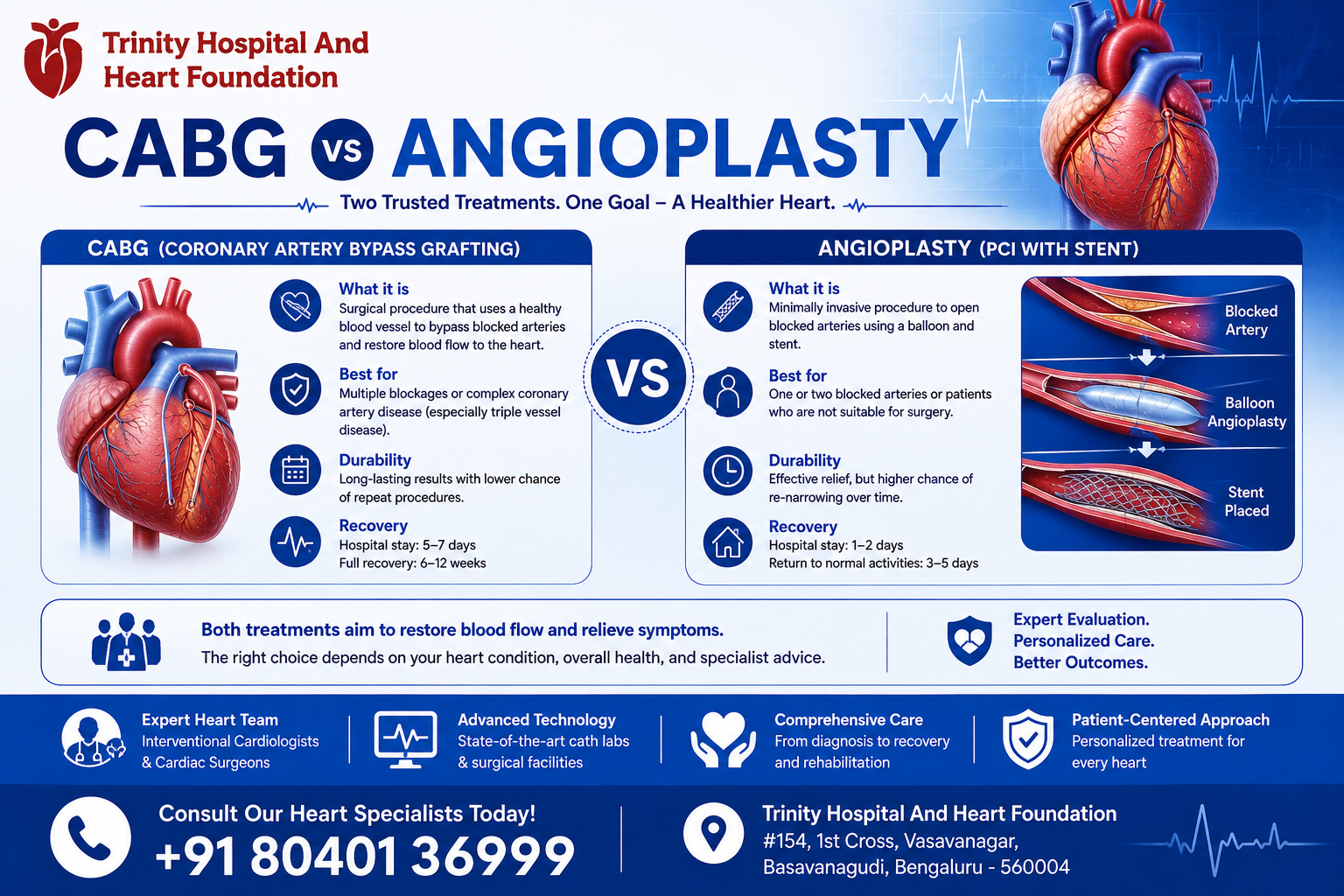
In simple terms:
The choice depends on the patient’s coronary anatomy and overall clinical situation.
CABG surgery, or coronary artery bypass grafting, is a surgical procedure used to improve blood flow to the heart muscle.
During a coronary artery bypass graft, a healthy blood vessel is used to create a new pathway around a blocked or severely narrowed coronary artery.
The graft may be taken from a blood vessel in the chest, arm or leg.
The goal is to allow blood to reach the heart muscle beyond the blocked section.
CABG procedure may be considered for selected patients with:
The ACC/AHA/SCAI guideline notes that surgical revascularization may be reasonable for selected patients with stable ischemic heart disease and triple-vessel disease, while the benefit of PCI for survival in this setting is less certain.
For patients with diabetes and multivessel CAD involving the LAD who are appropriate surgical candidates, CABG is recommended in preference to PCI to reduce mortality and repeat revascularization.
Angioplasty is a minimally invasive treatment used to improve blood flow through a narrowed or blocked coronary artery.
It is also called:
During PCI, a catheter is guided through a blood vessel toward the coronary artery. A balloon may be used to widen the narrowed area, followed in many cases by placement of a stent.
A heart stent is a small mesh tube designed to help keep the treated artery open.
Trinity Hospital lists coronary angiography and coronary angioplasty with stenting among its interventional cardiology services.
PTCA with stent combines balloon angioplasty with placement of a coronary stent.
The basic concept is:
Narrowed artery → balloon treatment → stent placement → improved blood flow
A stent does not remove the underlying tendency to develop atherosclerosis. Long-term medical treatment and cardiovascular risk-factor management remain important after PCI.
The exact type of stent, medication plan and follow-up depend on the patient’s condition and the treating cardiologist’s recommendations.
A coronary angiogram is an imaging test used to examine the coronary arteries.
It is sometimes referred to as an angiogram for heart or cardiac angiography.
During coronary angiography, contrast material is introduced through a catheter, allowing doctors to visualize the coronary arteries and identify areas of narrowing or blockage.
A coronary angiogram can help doctors understand:
Trinity Hospital’s cardiology department describes coronary angiography as dye-based imaging used to map coronary artery blockages.
A coronary angiogram is a diagnostic test; angioplasty and CABG are treatment procedures.
| Factor | CABG | Angioplasty / PCI |
| Full form | Coronary Artery Bypass Grafting | Percutaneous Coronary Intervention |
| Approach | Surgical | Catheter-based |
| Main purpose | Creates a bypass around blocked arteries | Opens a narrowed or blocked artery |
| Stent | Not required for the bypass itself | Usually used when PCI involves stenting |
| Recovery | Generally longer | Usually shorter than surgical recovery |
| Complex multivessel disease | Often considered in suitable patients | May be appropriate depending on anatomy |
| Diabetes with certain multivessel disease | May be preferred in appropriate surgical candidates | May be considered when surgery is unsuitable |
| Other cardiac surgery | Can be combined with other surgical procedures when appropriate | Limited ability to address separate surgical conditions |
| Decision | Based on anatomy, symptoms, risk and overall health | Based on anatomy, feasibility, symptoms and clinical indication |
This table is a general comparison. Individual treatment decisions require clinical evaluation.
Angioplasty may be considered when the coronary anatomy is suitable for catheter-based treatment.
PCI may be appropriate for selected patients with:
The choice also depends on whether the disease is straightforward or technically complex.
Trinity Hospital provides coronary angioplasty and stenting as well as advanced procedures such as complex angioplasty with rotablation and intravascular ultrasound.
Bypass surgery may be preferred when the overall anatomy and clinical profile indicate that surgical revascularization is more appropriate.
This can include selected patients with:
The ACC/AHA/SCAI guideline states that for patients requiring revascularization who have complex or diffuse multivessel CAD, including high anatomical complexity, CABG may be reasonable over PCI to provide a survival advantage.
For significant left main coronary artery disease, surgical revascularization is generally indicated in appropriate patients, while PCI can be an option for selected patients with low-to-medium anatomical complexity and suitable anatomy.
In appropriate surgical candidates with diabetes and multivessel CAD involving the LAD, CABG is recommended in preference to PCI.
Some coronary blockages may be difficult to treat safely or effectively using a catheter-based approach because of their location, length, calcification or overall complexity.
There is no universal answer.
The appropriate treatment depends on the individual patient’s:
For patients where the optimal strategy is uncertain, the ACC/AHA/SCAI guideline recommends a multidisciplinary Heart Team and shared decision-making.
Therefore, searching for the “better” procedure without considering the coronary anatomy can be misleading.
Patients with triple-vessel coronary artery disease often require particularly careful treatment planning.
Triple-vessel disease means significant disease involving three major coronary vessels. The number of affected vessels alone does not automatically determine whether CABG or PCI should be performed.
Doctors may consider:
For stable ischemic heart disease with normal left ventricular function and significant triple-vessel disease, the 2021 guideline states that surgical revascularization may be reasonable to improve survival, while survival benefit from PCI is uncertain.
Diabetes is an important factor in coronary revascularization decisions.
People with diabetes can develop extensive coronary artery disease, and the pattern of disease may affect whether surgery or PCI is more appropriate.
For patients with diabetes and multivessel CAD involving the LAD who are appropriate candidates for CABG, current ACC/AHA/SCAI guidance recommends CABG in preference to PCI to reduce mortality and repeat revascularization.
However, patients who have high surgical risk or are poor candidates for surgery may still be considered for PCI when clinically appropriate.
The process usually begins with a detailed clinical evaluation.
Depending on the situation, investigations may include:
Trinity Hospital lists ECG, 2D echocardiography, TMT, CT coronary angiography and coronary angiography among its cardiac diagnostic services.
The coronary angiogram is particularly important when revascularization is being considered because it provides detailed information about the coronary anatomy.
After angioplasty or PTCA with stent, patients are generally prescribed medicines to reduce the risk of complications and maintain cardiovascular health.
Follow-up may include:
The exact medication regimen should be determined by the treating doctor.
Patients should not stop antiplatelet or other prescribed cardiac medication without medical advice.
Recovery after CABG surgery is generally longer than after PCI because bypass surgery is a major cardiac operation.
Recovery may include:
The length of recovery varies depending on age, general health, surgical complexity and whether additional procedures were performed.
Both treatments have potential risks.
These may include:
Potential complications may include:
Individual risk varies significantly. The treating team should explain the risks and expected benefits before a procedure.
In some complex situations, different coronary arteries may require different treatment approaches.
For example, a patient may undergo PCI for a specific lesion while another part of the coronary anatomy is managed surgically or medically.
The treatment plan depends on the coronary anatomy and clinical circumstances.
The goal is not simply to choose a procedure but to achieve an appropriate overall revascularization strategy.
A coronary artery bypass graft and a heart stent solve coronary blood-flow problems in different ways.
Creates a new route around a blocked artery.
Supports the treated section of an artery after catheter-based angioplasty.
A heart stent is therefore part of a PCI treatment strategy, whereas a bypass graft is part of CABG.
Neither should be selected based only on convenience or recovery time.
Angioplasty is often described by patients as heart stent surgery, but medically it is a catheter-based interventional procedure rather than conventional open-heart surgery.
PTCA uses a catheter and balloon to widen a narrowed coronary artery, while stenting may be performed to help keep the treated artery open.
This distinction is useful when discussing expected recovery and procedural risks.
Trinity Hospital and Heart Foundation in Basavanagudi provides an integrated cardiac pathway involving diagnostics, interventional cardiology and cardiothoracic surgery.
The current cardiology department lists:
The department describes a team-based approach involving cardiology consultants, technicians, nursing staff and referring doctors, with coordinated interpretation of diagnostic findings and openness to second opinions or external referrals when required.
Dr. B. G. Muralidhara is listed by Trinity Hospital as a Senior Interventional Cardiologist.
His published profile lists the following qualifications:
The profile states that he has more than three decades of experience in cardiology and reports experience with more than 10,000 angioplasties, 60,000 coronary angiograms, and 2,000 pacemaker implantations.
His listed areas of expertise include:
His profile describes an evidence-based, patient-centred approach focused on detailed evaluation, diagnosis and individualized treatment planning.
The cost of CABG surgery and angioplasty varies from patient to patient.
Factors may include:
A cost estimate should be discussed after the patient’s cardiac condition has been evaluated. The lower initial cost of one procedure should not be the sole factor in choosing between CABG and PCI.
A cardiology evaluation may be appropriate if you have:
Ongoing or recurring chest pain, especially when accompanied by breathlessness, dizziness or other concerning symptoms, should be medically evaluated. Acute or severe cardiac symptoms require emergency medical attention. Trinity Hospital’s department similarly advises prompt assessment for ongoing or recurring chest pain associated with breathlessness or dizziness.
The choice between CABG vs angioplasty should be based on the patient’s coronary anatomy, clinical condition and long-term treatment goals—not simply on whether one procedure is less invasive or has a shorter recovery.
Angioplasty, PTCA with stent, and coronary artery bypass graft surgery each have an important role in coronary artery disease. A detailed evaluation can help determine which approach, or combination of approaches, is appropriate.
Trinity Hospital and Heart Foundation in Basavanagudi provides cardiac diagnostic, interventional and surgical services to support evaluation and treatment planning
 24 Hour Emergency Aid